
Abstract
Background
Salmonella infections are an important cause of foodborne illness and may present with a broad clinical spectrum, ranging from mild gastroenteritis to invasive systemic infections. This study aimed to evaluate the epidemiological, clinical, and microbiological characteristics of Salmonella infections in adults at a tertiary care center.
Materials and Methods
In this retrospective study, patients aged ≥18 years with Salmonella spp. isolated from clinical specimens between January 2014 and December 2023 were included. Demographic data, clinical findings, culture results, and antimicrobial susceptibility profiles were evaluated using the hospital electronic database.
Results
A total of 82 adult patients were included. Of the patients, 53.7% were male and the mean age was 53.1 ± 20.46 years. Acute enteritis was the most common clinical presentation (56.1%). Salmonella was most frequently isolated from stool samples (67.2%). Bacteremia was detected in 15.9% of the patients. Clinically confirmed urinary tract infections were identified in three patients, while various extraintestinal infections were also observed. Most cases occurred during the summer months (54.9%). Ciprofloxacin resistance among Salmonella isolates was notable.
Conclusion
Salmonella infections in adults encompass a broad clinical spectrum, ranging from self-limited gastroenteritis to invasive bacteremia and focal extraintestinal infections. Invasive disease occurred particularly among older and immunosuppressed patients; the notable ciprofloxacin resistance observed in our region underscores the importance of continuous regional surveillance of antimicrobial resistance to guide empirical treatment strategies.
Keywords: Salmonella infections, Salmonella enterica, bacteremia, antimicrobial resistance, extraintestinal infections
Introduction
Salmonella infections remain among the leading causes of foodborne bacterial diseases worldwide and continue to pose a substantial public health burden. According to the European Centre for Disease Prevention and Control, salmonellosis is one of the most frequently reported zoonotic infections in Europe, with a considerable number of hospitalizations and outbreaks reported annually despite ongoing improvements in food safety and surveillance systems (). Although the majority of infections are self-limiting, severe disease may occur in vulnerable populations, contributing significantly to healthcare utilization and economic burden (, ).
Salmonella spp. are Gram-negative, facultative intracellular bacilli that belong to the family Enterobacteriaceae and are primarily transmitted through contaminated food products, particularly those of animal origin. Clinical manifestations range from uncomplicated gastroenteritis to invasive infections, including bacteremia and focal extraintestinal infections involving the osteoarticular system, endovascular structures, intra-abdominal organs, and urinary tract. Invasive salmonellosis is associated with prolonged hospitalization, increased morbidity, and higher mortality, especially among elderly patients and those with immunosuppressive conditions or chronic comorbidities (, ).
The emergence and global dissemination of antimicrobial-resistant Salmonella strains have become an increasing clinical concern. Resistance to fluoroquinolones, third-generation cephalosporins, and other commonly prescribed antimicrobial agents may compromise empirical treatment, particularly in invasive infections. Because antimicrobial susceptibility patterns vary considerably across geographical regions and change over time, continuous local surveillance is essential for guiding empirical therapy and supporting antimicrobial stewardship programs (, ).
Recent studies from Türkiye have primarily reported antimicrobial resistance and microbiological surveillance data on Salmonella isolates (, ), whereas long-term studies integrating clinical characteristics, invasive and extraintestinal manifestations, seasonal distribution, and antimicrobial susceptibility patterns specifically in adult patients remain limited. The present study addresses this gap by providing a 10-year real-world evaluation of these characteristics within the same adult cohort. In addition, comparisons between patients with and without bacteremia and between gastrointestinal and extraintestinal infections provide further information on the clinical profiles associated with invasive presentations. Therefore, this study aimed to comprehensively evaluate the epidemiological, clinical, and microbiological characteristics and antimicrobial susceptibility patterns of adult Salmonella infections managed at a tertiary care center over a 10-year period.
Materials and Methods
This retrospective study included adult patients (≥18 years) with Salmonella isolated from clinical specimens between January 1, 2014, and December 31, 2023. Patients were identified through the microbiology laboratory database. Both hospitalized patients and outpatients who were evaluated by or referred to the department of infectious diseases and clinical microbiology were screened for eligibility. Only the first Salmonella isolate from each patient during a single infection episode was included; whereas duplicate isolates from the same episode were excluded. Demographic characteristics, epidemiological data, clinical manifestations, microbiological findings, antimicrobial susceptibility results, treatment information, and clinical outcomes were retrospectively extracted from the hospital’s electronic medical records.
Because routine serotyping was not performed during the study period, typhoidal and non-typhoidal Salmonella infections could not be microbiologically distinguished. Nevertheless, patients with a clinical diagnosis of enteric (typhoid) fever were identified and analyzed separately based on their clinical records.
Clinical specimens were processed according to standard microbiological procedures. Stool specimens were cultured on selective enteric media, whereas non-stool specimens were inoculated on routine bacteriological media. Suspected Salmonella isolates were identified using conventional microbiological methods and the VITEK® 2 Compact automated identification system (bioMérieux, Marcy-l’Étoile, France).
Antimicrobial susceptibility testing was performed using the VITEK® 2 Compact automated system. Minimum inhibitory concentration (MIC) values were interpreted according to the Clinical and Laboratory Standards Institute criteria in effect when each isolate was tested. Susceptibility results for routinely tested antimicrobial agents were retrieved from the laboratory database. Susceptibility testing for nalidixic acid and pefloxacin was not routinely performed during the study period.
Patients from whom Salmonella was isolated in urine cultures were re-evaluated based on clinical and laboratory findings. A urinary tract infection was diagnosed only in the presence of compatible urinary symptoms, pyuria, and supportive clinical findings; patients lacking these criteria were not classified as having a urinary tract infection. Extraintestinal Salmonella infections were classified according to clinical, microbiological, radiological, and surgical findings.
Ethics Statement
The study protocol was approved by the University of Health Sciences Türkiye, Antalya Training and Research Hospital Institutional Ethics Committee (decision number: 9/19; date: 13 June 2024). Due to the retrospective design of the study, written informed consent was waived.
Statistical Analysis
Statistical analyses were performed using IBM SPSS Statistics for Windows, version 21.0 (IBM Corp., Armonk, NY, USA). Continuous variables were assessed for distribution and are presented as mean ± standard deviation (SD) or median with interquartile range (IQR), as appropriate. Categorical variables are presented as numbers (n) and percentages (%). Comparisons between two independent groups were performed using the Mann–Whitney U test for continuous variables and the chi-square test or Fisher’s exact test, as appropriate, for categorical variables. Because the primary objective of the study was to describe the epidemiological, clinical, and microbiological characteristics of adult Salmonella infections, descriptive analyses constituted the primary analytical approach. Missing data were excluded from the relevant analyses, and percentages were calculated based on the number of patients with available data. A two-sided p value <0.05 was considered statistically significant.
Results
A total of 82 adult patients with Salmonella infection were included in the study. The median age was 53 years (IQR, 34.3–71.0), and 38 patients (46.3%) were female. The most common comorbidities were hypertension (32.5%) and diabetes mellitus (27.5%), while immunosuppressive diseases and immunosuppressive medication use were present in 17.3% and 21.0% of the patients, respectively. Fifty-seven patients (69.5%) required hospitalization; the median hospital stay was 9.5 days (IQR, 5.0–16.8). Gastrointestinal infection was the most common clinical presentation (64.7%), followed by extraintestinal infection (18.3%) and isolated bacteremia (15.9%). Baseline demographic, clinical, and laboratory characteristics are summarized in .
Table 1. Baseline demographic, clinical, and laboratory characteristics of patients with Salmonella infection (n = 82).
Characteristic | Value |
|---|---|
Demographic characteristics | |
Age, years, median (IQR) | 53 (34.3–71.0) |
Female sex, n (%) | 38 (46.3) |
Comorbidities, n (%) | |
Diabetes mellitus | 22 (27.5) |
Hypertension | 26 (32.5) |
Immunosuppressive disease | 14 (17.3) |
Immunosuppressive medication | 17 (21.0) |
Sickle cell disease | 2 (2.5) |
Clinical characteristics, n (%) | |
Hospitalization | 57 (69.5) |
Length of hospital stay, days, median (IQR) | 9.5 (5.0–16.8) |
Surgery | 8 (9.8) |
Mortality | 1 (1.2) |
Clinical presentation, n (%) | |
Gastrointestinal infection | 53 (64.7) |
Extraintestinal infection | 15 (18.3) |
Isolated bacteremia | 13 (15.9) |
Multiple system involvement | 2 (2.4) |
Laboratory findings | |
White blood cell count (/mm3), median (IQR) | 10.250 (6.825–16.175) |
Neutrophil count (/mm3), median (IQR) | 7.900 (4.570–12.900) |
Lymphocyte count (/mm3), median (IQR) | 900 (650–1.030) |
Platelet count (/mm3), median (IQR) | 195.000 (137.500–263.000) |
C-reactive protein (mg/L), median (IQR) | 189 (117.5–264.0) |
IQR, interquartile range.
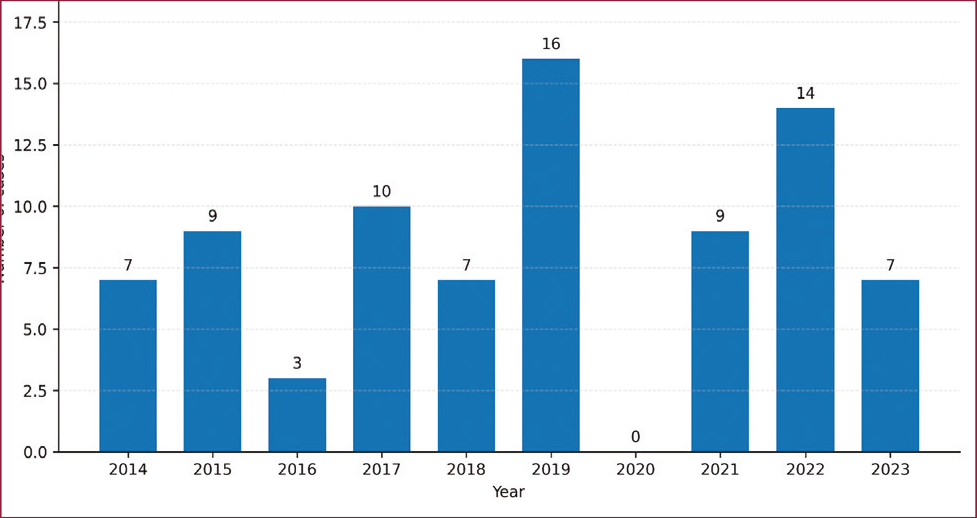
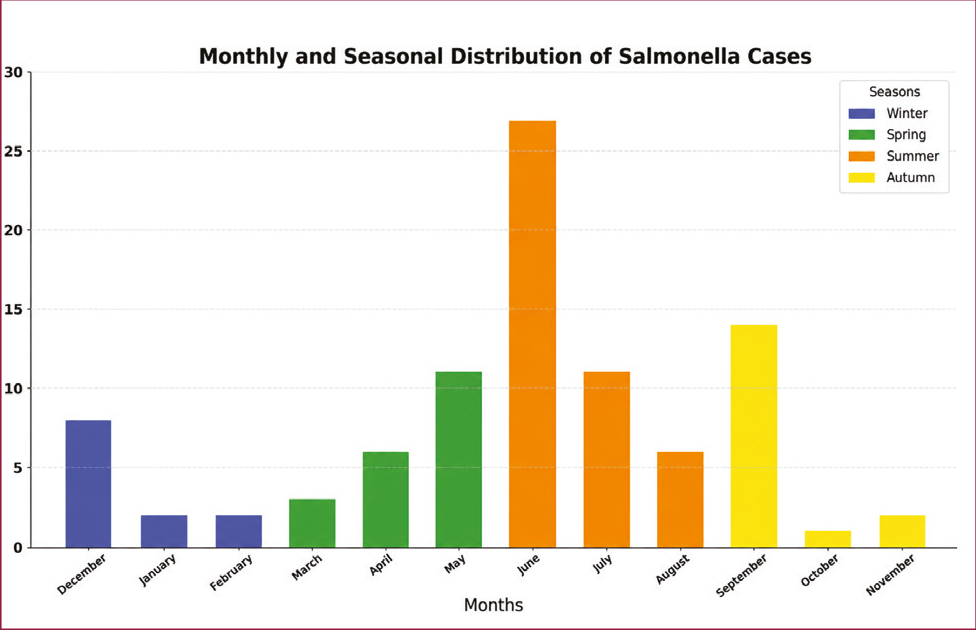
The annual and seasonal distributions of Salmonella infection cases are presented in and . Cases were identified in all study years except 2020, with seasonal clustering during the summer months. Overall, 54.9% of the infections occurred during summer, and June was the most frequent month of presentation, accounting for 32.9% of all cases.
The most common presenting symptom was nausea (70.4%), followed by diarrhea (59.3%), vomiting (56.8%), and abdominal pain (55.6%). Fever was present in 41.5% of the patients, and constitutional symptoms such as fatigue (40.2%) and loss of appetite (30.5%) were frequently observed. Neurological manifestations (including altered consciousness (7.4%), bloody diarrhea (4.9%), and skin rash (1.2%) were uncommon.
The clinical presentations of adult Salmonella infections are summarized in . Gastrointestinal infection was the most common presentation (64.7%), predominantly manifesting as acute enteritis (56.1%). Isolated bacteremia accounted for 15.9% of patients, whereas extraintestinal infections were identified in 18.3% of patients. Among patients with extraintestinal infections, other localized infections (8.5%) were the most frequent, followed by musculoskeletal infections (6.1%) and urinary tract infections (3.7%).
Table 2. Clinical presentations of adult Salmonella infections.
Clinical presentation | n (%) |
|---|---|
Gastrointestinal group | 53 (64.7) |
Acute enteritis | 46 (56.1) |
Enteric fever | 2 (2.4) |
Asymptomatic carriage | 5 (6.1) |
Isolated bacteremia | 13 (15.9) |
Extraintestinal infection | 15 (18.3) |
Urinary tract infection | 3 (3.7) |
Musculoskeletal infection | 5 (6.1) |
Other localized infections* | 7 (8.5) |
*Other localized infections included splenic abscess (n = 1), pneumonia (n = 1), peritonitis (n = 1), adnexal infection (n = 1), and soft tissue infection (n = 3).
Antimicrobial susceptibility results are presented in . Overall, Salmonella spp. remained highly susceptible to most antimicrobial agents tested. Resistance rates were 13.3% for ampicillin, 21.8% for ciprofloxacin, 7.7% for ceftriaxone, and 1.2% for trimethoprim-sulfamethoxazole.
Table 3. Antimicrobial susceptibility profile of Salmonella isolates.
Antimicrobial agent | Susceptible, n (%) | Resistant, n (%) |
Ampicillin | 65 (86.7) | 10 (13.3) |
Ciprofloxacin | 61 (78.2) | 17 (21.8) |
Ceftriaxone | 72 (92.3) | 6 (7.7) |
Trimethoprim–sulfamethoxazole | 79 (98.8) | 1 (1.2) |
compares the clinical and laboratory characteristics of patients with and without Salmonella bacteremia. Compared with non-bacteremic patients, those with Salmonella bacteremia were significantly older, had lower platelet counts, had longer hospital stays, and more frequently had underlying immunosuppressive diseases and were using immunosuppressive medications (all p < 0.05). No significant differences were observed between the groups regarding sex, diabetes mellitus, hypertension, white blood cell count, neutrophil count, lymphocyte count, or C-reactive protein levels.
Table 4. Comparison of demographic, clinical, and laboratory characteristics between patients with and without Salmonella bacteremia.
Variable | No bacteremia (n = 69) | Bacteremia (n = 13) | p value |
|---|---|---|---|
Demographic characteristics | |||
Age, years | 48 (33–65) | 70 (63–77) | 0.010 |
Female sex, n (%) | 34 (49.3) | 4 (30.8) | 0.245 |
Comorbidities | |||
Diabetes mellitus, n (%) | 18 (26.1) | 4 (30.8) | 0.745 |
Hypertension, n (%) | 20 (29.0) | 6 (46.2) | 0.333 |
Immunosuppressive disease, n (%) | 9 (13.0) | 5 (38.5) | 0.043 |
Immunosuppressive medication use, n (%) | 11 (15.9) | 6 (46.2) | 0.025 |
Sickle cell disease, n (%) | 1 (1.4) | 1 (7.7) | 0.297 |
Clinical outcomes | |||
Hospitalization, n (%) | 45 (65.2) | 12 (92.3) | 0.096 |
Length of hospital stay, days | 6.5 (5–14) | 17 (12–21.8) | 0.007 |
Surgery required, n (%) | 8 (11.6) | 0 (0.0) | 0.344 |
Mortality, n (%) | 1 (1.4) | 0 (0.0) | 1.000 |
Laboratory findings | |||
White blood cell count (/mm3) | 10.350 (7.000–15.775) | 8.150 (2.675–17.875) | 0.424 |
Absolute neutrophil count (/mm3) | 8.100 (4.950–12.893) | 6.400 (1.853–13.375) | 0.371 |
Absolute lymphocyte count (/mm3) | 900 (653–1.175) | 805 (425–980) | 0.120 |
C-reactive protein, mg/L | 193 (121–275) | 151 (118–236) | 0.332 |
Platelet count (/mm3) | 210,500 (151.750–267.000) | 112,500 (64,750–132,250) | <0.001 |
Data are presented as median (interquartile range) for continuous variables and number (percentage) for categorical variables. Continuous variables were compared using the Mann–Whitney U test, and categorical variables using the χ2 test or Fisher’s exact test, as appropriate. Statistically significant p values are shown in bold.
compares the clinical and laboratory characteristics of patients with gastrointestinal and extraintestinal Salmonella infections. Compared with patients with gastrointestinal infection, those with extraintestinal infection were significantly older, more frequently female, and had a higher prevalence of diabetes mellitus. In addition, patients with extraintestinal infections required hospitalization and surgical intervention more often, and had significantly longer hospital stays (all p < 0.05). No significant differences were observed between the groups regarding hypertension, immunosuppressive disease, immunosuppressive medication use, white blood cell count, neutrophil count, lymphocyte count, platelet count, C-reactive protein levels, or mortality.
Table 5. Comparison of demographic, clinical, and laboratory characteristics between patients with gastrointestinal and extraintestinal Salmonella infections (patients with isolated bacteremia excluded).
Variable | Gastrointestinal infection (n = 53) | Extraintestinal infection (n = 15) | p value |
|---|---|---|---|
Demographic characteristics | |||
Age, years | 44 (32–60) | 62 (51.5–77.5) | 0.013 |
Female sex, n (%) | 21 (38.9) | 13 (86.7) | 0.001 |
Comorbidities | |||
Diabetes mellitus, n (%) | 11 (20.8) | 7 (50.0) | 0.042 |
Hypertension, n (%) | 17 (32.1) | 3 (21.4) | 0.528 |
Immunosuppressive disease, n (%) | 5 (9.4) | 4 (26.7) | 0.100 |
Immunosuppressive medication use, n (%) | 8 (15.1) | 3 (20.0) | 0.696 |
Sickle cell disease, n (%) | 0 (0.0) | 1 (6.7) | 0.221 |
Clinical outcomes | |||
Hospitalization, n (%) | 31 (57.4) | 14 (93.3) | 0.013 |
Length of hospital stay, days | 5 (5–7.5) | 16.5 (13.2–28.2) | <0.001 |
Surgery required, n (%) | 1 (1.9) | 7 (46.7) | <0.001 |
Mortality, n (%) | 1 (1.9) | 0 (0.0) | 1.000 |
Laboratory findings | |||
White blood cell count (/mm3) | 10,150 (6,975–15,450) | 10,800 (7,425–14,700) | 0.793 |
Absolute neutrophil count (/mm3) | 7,950 (4,900–12,200) | 8,600 (5,450–11,900) | 0.543 |
Absolute lymphocyte count (/mm3) | 905 (650–1,180) | 870 (590–1,060) | 0.581 |
C-reactive protein, mg/L | 184.5 (119–269) | 238 (136–284) | 0.760 |
Platelet count (/mm3) | 206,000 (151,000–264,000) | 237,000 (169,000–286,000) | 0.357 |
Data are presented as median (interquartile range) for continuous variables and number (percentage) for categorical variables. Continuous variables were compared using the Mann–Whitney U test, and categorical variables using the χ2 test or Fisher’s exact test, as appropriate. Patients with isolated Salmonella bacteremia were excluded from this analysis. Statistically significant p values are shown in bold.
Temporal trends in antimicrobial resistance during the study period are presented in . An increase in ciprofloxacin resistance was observed from 15.6% in 2014–2018 to 26.1% in 2019–2023; however, this difference was not statistically significant (p = 0.404). Resistance rates to ampicillin, ceftriaxone, and trimethoprim-sulfamethoxazole also remained stable over time, with no statistically significant differences observed between the two study periods.
Table 6. Comparison of antimicrobial resistance rates between the 2014–2018 and 2019–2023 study periods.
Antimicrobial agent | 2014–2018 n/N (%) | 2019–2023 n/N (%) | p value |
Ampicillin | 5/33 (15.2) | 5/42 (11.9) | 0.741 |
Ciprofloxacin | 5/32 (15.6) | 12/46 (26.1) | 0.404 |
Ceftriaxone | 3/33 (9.1) | 3/45 (6.7) | 0.694 |
Trimethoprim–sulfamethoxazole | 0/35 (0.0) | 1/45 (2.2) | 1.000 |
*Data are presented as the number of resistant isolates/number of isolates tested (%). Comparisons between the two study periods were performed using Fisher’s exact test.
Discussion
This 10-year adult cohort study provides an integrated evaluation of the clinical spectrum, invasive and extraintestinal manifestations, seasonal distribution, and antimicrobial susceptibility patterns of Salmonella infections in a tertiary care setting. By additionally comparing bacteremic and non-bacteremic patients and gastrointestinal and extraintestinal presentations, our study provides real-world clinical data that complement the predominantly microbiological and antimicrobial resistance-focused reports previously published from Türkiye (56). Gastrointestinal infection was the most common clinical presentation. More than half of the cases occurred during the summer months, and ciprofloxacin resistance was observed at a notable rate among Salmonella isolates. In addition, patients with Salmonella bacteremia were older, were more frequently immunosuppressed, had lower platelet counts, and had longer hospital stays than non-bacteremic patients. Similarly, patients with extraintestinal infections were older, were more frequently female, had a higher prevalence of diabetes mellitus, more often required surgical intervention, and experienced longer hospital stays than those with gastrointestinal infections.
Although gastrointestinal infection was the predominant clinical presentation in our cohort, a substantial proportion of patients presented with invasive manifestations, including isolated bacteremia, extraintestinal infections, or involvement of multiple systems. Notably, nausea was reported more frequently than diarrhea in our cohort (70.4% vs. 59.3%). Although diarrhea is a typical manifestation of Salmonella gastroenteritis, this presentation is not uncommon in adults. In a systematic review of the global clinical and laboratory profile of enteric fever, nausea/vomiting was reported in 49% of adults compared with diarrhea in 46% (). The predominance of nausea in our cohort may partly reflect its selected clinical profile, as a substantial proportion of patients were hospitalized and invasive or extraintestinal presentations were common. However, because the systematic review primarily evaluated enteric fever and serotyping was not routinely available in our study, this comparison should be interpreted with caution. While Salmonella infections are typically self-limiting and present as gastroenteritis, bacteremia and focal extraintestinal infections may occur, particularly in older adults and in patients with immunosuppression or underlying chronic diseases (, ). Our findings highlight the broad clinical spectrum of adult Salmonella infections and emphasize the importance of considering invasive disease in patients at increased risk.
In our cohort, patients with Salmonella bacteremia were older, more frequently immunosuppressed, had lower platelet counts, and had longer hospital stays than those without bacteremia. Previous population-based and adult cohort studies have identified advanced age as an important risk factor for non-typhoidal Salmonella bacteremia (, ), while immunosuppression has been consistently associated with the development of primary and recurrent bacteremia (-). Our findings are consistent with these reports and further emphasize the importance of careful clinical assessment for invasive Salmonella infection in older and immunocompromised patients. In addition, patients with bacteremia had significantly lower platelet counts. Thrombocytopenia has been described in severe Salmonella infections complicated by sepsis, disseminated intravascular coagulation (DIC), or multiple organ involvement (-). Importantly, higher-level evidence also supports thrombocytopenia as a relevant laboratory finding in adult enteric fever: a systematic review reported thrombocytopenia in approximately 52% of adult patients (). However, this systematic review focused primarily on enteric fever, and evidence on the specific association between thrombocytopenia and bacteremia in adults with Salmonella infection remains limited. Therefore, the lower platelet counts observed in our bacteremic patients should be interpreted cautiously and require confirmation in larger, appropriately adjusted cohort studies.
Urinary tract involvement due to Salmonella was uncommon in our cohort. Although Salmonella was isolated from urine cultures in seven patients, only three met the clinical and laboratory criteria for urinary tract infection, whereas the remaining cases were considered to represent colonization or contamination because they lacked compatible urinary symptoms and supportive urinalysis findings. This distinction is clinically important, as previous studies have emphasized that the diagnosis of Salmonella urinary tract infection should rely on the combination of microbiological, clinical, and laboratory findings rather than urine culture positivity alone ().
In addition to urinary involvement, several uncommon focal extraintestinal infections were identified, including septic arthritis, peritonitis, splenic abscess, soft tissue infection, pneumonia, and adnexal infection. These findings further illustrate the broad clinical spectrum of invasive Salmonella disease, although such focal infections remain relatively uncommon (). The predominance of female patients (86.7%) in the extraintestinal infection group was an unexpected finding. Given the small number of patients with extraintestinal infection (n = 15), the absence of multivariable adjustment, and the lack of a clear biological explanation, this finding may reflect chance or be attributable to the composition of our study population, and should not be interpreted as evidence of an independent association between female sex and extraintestinal Salmonella infection. Furthermore, Salmonella was isolated from bile specimens obtained during cholecystectomy in two patients who had no clinical evidence of acute cholecystitis. These cases were considered more consistent with chronic gallbladder carriage than active infection, which is in accordance with previous studies demonstrating that Salmonella can persist in the gallbladder by forming biofilms on gallstones and the gallbladder epithelium ().
Among the antimicrobial agents evaluated, ciprofloxacin exhibited the highest resistance rate (21.8%) in our cohort. A numerical increase in ciprofloxacin resistance was observed from 15.6% during 2014–2018 to 26.1% during 2019–2023; however, this difference was not statistically significant (p = 0.404), and no significant temporal changes were observed for any of the tested antimicrobial agents. Nevertheless, the relatively high ciprofloxacin resistance observed in our study is consistent with the growing concern regarding fluoroquinolone resistance in Salmonella worldwide. Recent reports from Türkiye have also highlighted increasing fluoroquinolone resistance among non-typhoidal Salmonella isolates, emphasizing the need for continuous surveillance (). Similarly, European surveillance data indicate that resistance to fluoroquinolones remains one of the major challenges in the management of salmonellosis, whereas resistance to third-generation cephalosporins generally remains low (). In our cohort, ceftriaxone and trimethoprim–sulfamethoxazole retained excellent in vitro activity, with resistance rates of only 7.7% and 1.2%, respectively, supporting their continued role as effective therapeutic options when clinically indicated. Comparable findings have been reported in recent clinical studies from Türkiye and Europe, in which resistance to ceftriaxone and trimethoprim–sulfamethoxazole remained relatively low despite increasing resistance to fluoroquinolones (, ). However, given the global emergence of multidrug-resistant Salmonella strains and the ongoing spread of fluoroquinolone resistance, continuous epidemiological surveillance and prudent antimicrobial use remain essential to preserve the effectiveness of currently available treatment options (, ). A distinct seasonal pattern was observed in our cohort, with 54.9% of cases occurring during the summer months and the highest incidence recorded in June (32.9%). This finding is consistent with previous epidemiological studies demonstrating a marked increase in non-typhoidal Salmonella infections during warmer months. A recent systematic review and meta-analysis including 44 studies from 27 countries reported high-certainty evidence of a positive association between ambient temperature and the incidence of non-typhoidal Salmonella infection, with an estimated 5% increase in infection risk for every 1°C rise in temperature (). Similarly, Lal et al. () demonstrated that salmonellosis consistently exhibits a pronounced summer peak across diverse geographical regions, despite variations in climate and local epidemiology. Warmer temperatures promote bacterial multiplication in food and the environment, while seasonal behavioral changes, including increased outdoor dining, barbecues, picnics, and consumption of inadequately refrigerated food products, further facilitate foodborne transmission. The peak incidence in our cohort occurred in June rather than later summer months, suggesting that the Mediterranean climate of southern Türkiye, where high ambient temperatures are reached early in the season, may contribute to the earlier onset of seasonal transmission. These findings highlight the importance of reinforcing food safety practices and public health awareness campaigns before and during the summer season. Notably, no cases meeting the study inclusion criteria were identified in 2020. This finding coincided with the Coronavirus Disease-2019 pandemic and may reflect pandemic-related changes, including reduced healthcare-seeking behavior, reduced diagnostic testing or culture sampling, and altered exposure patterns during periods of public health restrictions. However, because of the retrospective design of our study, the specific reason for the absence of cases in 2020 could not be determined.
Study Limitations
This study has several limitations. First, its retrospective single-center design may have resulted in incomplete documentation of some clinical and epidemiological variables. Although adult patients with Salmonella infection at our center are generally evaluated in the Infectious Diseases outpatient clinic or the consultation service, including patients evaluated by our department may have introduced selection bias. Mild or self-limited gastroenteritis cases that did not require evaluation by Infectious Diseases may, therefore, have been underrepresented, potentially resulting in a relative overrepresentation of hospitalized, invasive, or complicated cases. Consequently, the observed rates of bacteremia (15.9%) and extraintestinal infection (18.3%) should be interpreted in the context of this selected clinical cohort and may not reflect the overall rates of Salmonella infections at our center. Second, the relatively small sample size may have limited the statistical power of subgroup analyses and the generalizability of the findings. Because the number of bacteremic patients was relatively small, a multivariable analysis was not performed. Therefore, the variables that differed significantly between bacteremic and non-bacteremic patients should be interpreted as unadjusted associations rather than independent risk factors, and potential confounding among these variables cannot be excluded. Third, because serotyping was not available for all isolates, typhoidal and non-typhoidal Salmonella infections could not be distinguished microbiologically. In addition, MIC data were not available for all isolates, which precluded a more detailed analysis of resistance levels; molecular mechanisms of antimicrobial resistance were not investigated. Finally, long-term clinical outcomes and relapse rates could not be assessed because follow-up data were unavailable for some patients. Despite these limitations, this study provides valuable real-world data from a 10-year adult cohort and offers a comprehensive evaluation of the clinical characteristics, invasive manifestations, seasonal distribution, and antimicrobial susceptibility patterns of Salmonella infections in a tertiary care setting.
Conclusion
Salmonella infections in adults encompass a broad clinical spectrum, ranging from self-limited gastroenteritis to bacteremia and diverse focal extraintestinal infections. In our cohort, invasive disease was observed in a considerable proportion of patients, particularly among older adults and those with underlying immunosuppressive conditions, underscoring the importance of careful clinical evaluation in high-risk populations. Although ceftriaxone and trimethoprim-sulfamethoxazole retained good in vitro activity, the relatively high ciprofloxacin resistance observed in our region highlights the need for ongoing local antimicrobial resistance surveillance. Regional epidemiological and antimicrobial susceptibility data remain essential for informing empirical treatment decisions and optimizing the management of adult Salmonella infections.
Footnotes
Ethics
Ethics Committee Approval: The study protocol was approved by the University of Health Sciences Türkiye, Antalya Training and Research Hospital Institutional Ethics Committee (decision number: 9/19; date: 13 June 2024).
Informed Consent: Due to the retrospective design of the study, written informed consent was waived.
Authorship Contributions
Surgical and Medical Practices: A.S.K., D.S., K.D.Ö., A.E., Concept: A.S.K., D.S., Design: A.S.K., D.S., K.D.Ö., Data Collection or Processing: A.S.K., K.D.Ö., A.E., Analysis or Interpretation: A.S.K., D.S., K.D.Ö., Literature Search: A.S.K., D.S., K.D.Ö., A.E., Writing: A.S.K., D.S., K.D.Ö.
Conflict of Interest: No conflict of interest was declared by the authors.
Financial Disclosure: The authors declared that this study received no financial support.
References
European Centre for Disease Prevention and Control. Salmonellosis. In: ECDC. Annual epidemiological report for 2023. Stockholm: European Centre for Disease Prevention and Control; 2025.
Crump JA, Sjölund-Karlsson M, Gordon MA, Parry CM. Epidemiology, clinical presentation, laboratory diagnosis, antimicrobial resistance, and antimicrobial management of invasive Salmonella infections. Clin Microbiol Rev. 2015;28:901-937.
Pegues DA, Miller SI. Salmonella species, including Salmonella Typhi. In: Bennett JE, Dolin R, Blaser MJ, editors. Mandell, Douglas, and Bennett’s principles and practice of infectious diseases. 9th ed. Philadelphia (PA): Elsevier; 2020.
Nazir J, Manzoor T, Saleem A, Gani U, Bhat SS, Khan S, et al. Combatting Salmonella: a focus on antimicrobial resistance and the need for effective vaccination. BMC Infect Dis. 2025;25:84.
Beşli Y, Keske Ş, Dikenelli BE, Palaoğlu KE, Ergönül Ö. Alarming increase in fluoroquinolone resistance among non-typhoidal salmonella isolates. Clin Microbiol Infect. 2024;30:961-963.
Tanrıverdi Çaycı Y, Bıyık İ, Çınar C, Yoser M, Birinci A. Antibiotic resistance profiles of Salmonella species isolated between 2014-2024. Sağlık Bil Değer. 2025;15:168-171.
Azmatullah A, Qamar FN, Thaver D, Zaidi AK, Bhutta ZA. Systematic review of the global epidemiology, clinical and laboratory profile of enteric fever. J Glob Health. 2015;5:020407.
Popa GL, Papa MI. Salmonella spp. infection - a continuous threat worldwide. Germs. 2021;11:88-96.
Laupland KB, Schønheyder HC, Kennedy KJ, Lyytikäinen O, Valiquette L, Galbraith J, et al. Salmonella enterica bacteraemia: a multi-national population-based cohort study. BMC Infect Dis. 2010;10:95.
Koch K, Kristensen B, Holt HM, Ethelberg S, Mølbak K, Schønheyder HC. International travel and the risk of hospitalization with non-typhoidal Salmonella bacteremia. A Danish population-based cohort study, 1999-2008. BMC Infect Dis. 2011;11:277.
Dhanoa A, Fatt QK. Non-typhoidal Salmonella bacteraemia: epidemiology, clinical characteristics and its’ association with severe immunosuppression. Ann Clin Microbiol Antimicrob. 2009;8:15.
Hsu RB, Chen RJ, Chu SH. Risk factors for recurrent bacteremia in adult patients with nontyphoid salmonellosis. Am J Med Sci. 2004;328:315-318.
Ramos JM, García-Corbeira P, Aguado JM, Arjona R, Alés JM, Soriano F. Clinical significance of primary vs. secondary bacteremia due to nontyphoid Salmonella in patients without AIDS. Clin Infect Dis. 1994;19:777-780..
Yildirim I, Ceyhan M, Bayrakci B, Uysal M, Kuskonmaz B, Ozaltin F. A case report of thrombocytopenia-associated multiple organ failure secondary to Salmonella enterica serotype Typhi infection in a pediatric patient: successful treatment with plasma exchange. Ther Apher Dial. 2010;14:226-229.
Al Reesi M, Stephens G, McMullan B. Severe thrombocytopenia in a child with typhoid fever: a case report. J Med Case Rep. 2016;10:333.
Ahmed ME. Salmonella septic shock associated with DIC and thrombocytopenia in a young adult. Crit Care Shock. 2023;26:285-290.
Tena D, González-Praetorius A, Bisquert J. Urinary tract infection due to non-typhoidal Salmonella: report of 19 cases. J Infect. 2007;54:245-249.
Gonzalez-Escobedo G, Marshall JM, Gunn JS. Chronic and acute infection of the gall bladder by Salmonella Typhi: understanding the carrier state. Nat Rev Microbiol. 2011;9:9-14.
Pagani G, Parenti M, Franzetti M, Pezzati L, Bassani F, Osnaghi B, et al. Invasive and non-invasive human Salmonellosis cases admitted between 2015 and 2021 in four suburban hospitals in the metropolitan area of Milan (Italy): a multi-center retrospective study. Pathogens. 2023;12:1298.
Watkins LK, Luna S, Bruce BB, Medalla F, Reynolds JL, Ray LC, et al. Clinical outcomes of patients with nontyphoidal Salmonella infections by isolate resistance: Foodborne Diseases Active Surveillance Network, 10 US sites, 2004-2018. Clin Infect Dis. 2024;78:535-543.
Damtew YT, Tong M, Varghese BM, Anikeeva O, Hansen A, Dear K, et al. The impact of temperature on non-typhoidal Salmonella and Campylobacter infections: an updated systematic review and meta-analysis of epidemiological evidence. EBioMedicine. 2024;109:105393.
Lal A, Hales S, French N, Baker MG. Seasonality in human zoonotic enteric diseases: a systematic review. PLoS One. 2012;7:e31883.